

A green card for investors is available through the EB-5 Immigrant Investor Program. To qualify, an investor must put lawful capital into a qualifying U.S. business, keep the investment genuinely at risk, and create at least 10 full-time jobs for eligible U.S. workers.
The minimum investment is:
EB-5 can offer permanent residence for the investor, a spouse, and unmarried children under 21. But it is not a guaranteed purchase of a green card. The application requires detailed proof of where the money came from, how it moved to the U.S. project, and how the project will meet its job-creation duties.
For many families, the practical first steps are to choose between a direct business investment and a regional center project, review the project carefully, and prepare source-of-funds records before filing an EB-5 petition.
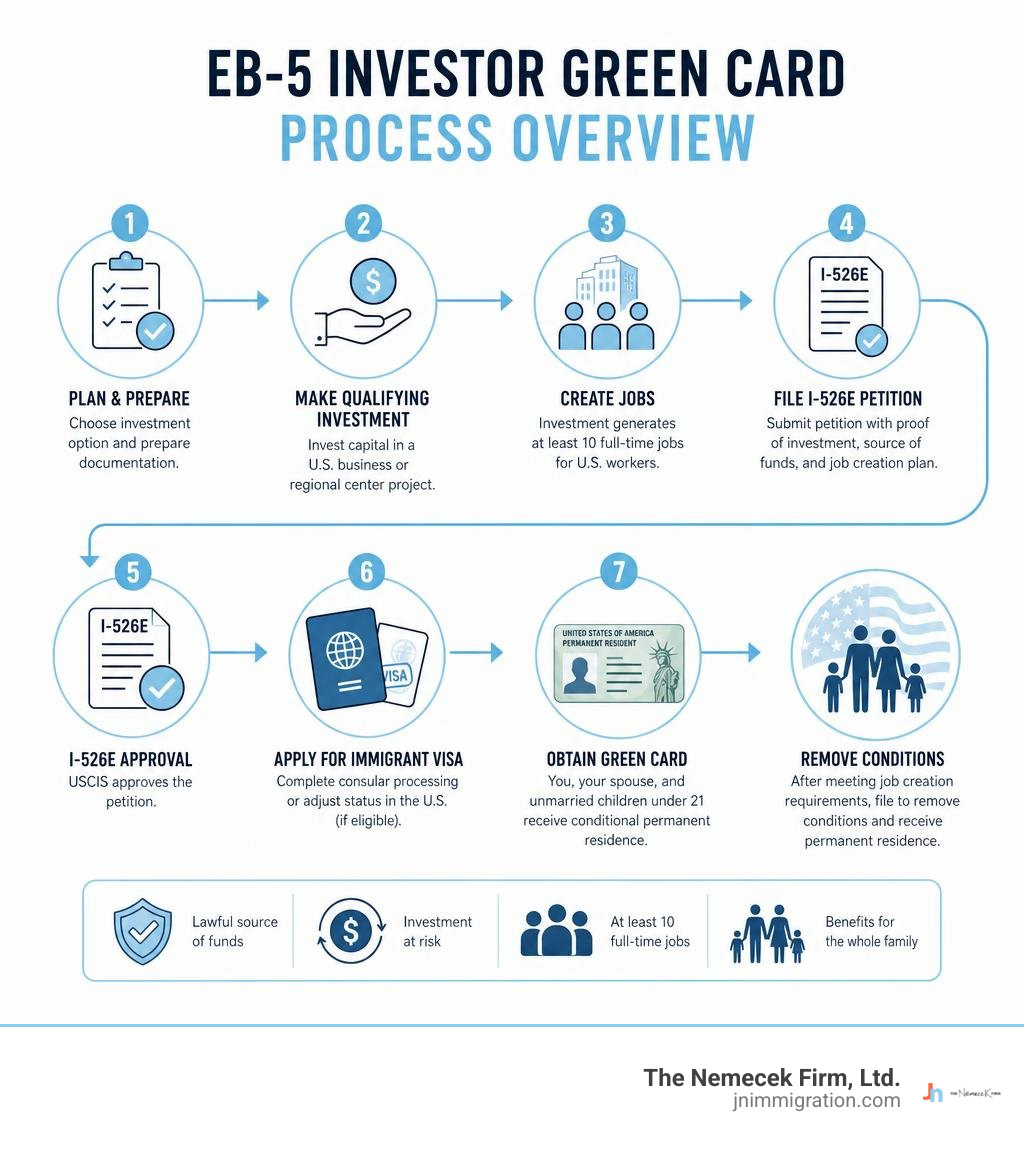

Congress established the EB-5 Immigrant Investor Program in 1990 to boost the American economy through capital infusion and job creation. Within the broader framework of employment based immigration, the Employment Fifth Preference (E5) visa category is allocated roughly 7.1% of the approximately 140,000 employment visas issued by the U.S. government each fiscal year.
Unlike most other permanent residence pathways, an investor petition does not require a sponsoring employer, nor does it require a test of the domestic labor market through the PERM labor certification process. However, the green card requirements for EB-5 are among the most stringent in immigration law regarding financial transparency, capital exposure, and job generation. As outlined by USCIS on the official Green Card for Immigrant Investors resource, an applicant must invest personal capital into a “new commercial enterprise” (NCE) established after November 29, 1990, or restructure an existing enterprise to expand its net worth or employee base substantially.
The statutory investment amounts for EB-5 petitions are bifurcated based on the geographical and economic profile of the enterprise location:
These statutory figures were codified under the EB-5 Reform and Integrity Act of 2022 (RIA). Under USCIS Policy Manual Chapter 2, minimum capital thresholds are subject to automatic inflation adjustments every five years. The next scheduled adjustment is set to take effect on January 1, 2027, indexed to the Consumer Price Index for All Urban Consumers (CPI-U), which will increase these minimum capital requirements.
Every EB-5 applicant must establish that their capital directly creates or preserves a minimum of 10 permanent full-time jobs for qualified U.S. workers (U.S. citizens, lawful permanent residents, asylees, or refugees). Full-time employment requires at least 35 hours per week. The investor, their spouse, and their children do not count toward this total.
Equally critical is proving the lawful source and path of investment funds. USCIS requires extensive forensic accounting to confirm that investment capital was not derived from illicit activities. Key standards include:
Navigating employment based immigration services for investors requires understanding the structural differences between Direct EB-5 investments and Regional Center EB-5 models. While both lead to the same permanent resident card, the operational realities, job counting methodologies, and regulatory filings differ significantly.
| Feature | Direct EB-5 Investment | Regional Center EB-5 Project |
|---|---|---|
| Primary USCIS Form | Form I-526 | Form I-526E |
| Minimum Investment | $800,000 (TEA) / $1,050,000 (Non-TEA) | $800,000 (TEA/Infrastructure) / $1,050,000 |
| Job Counting Method | Direct W-2 employees only (10 full-time jobs) | Direct, indirect, and induced jobs (economic modeling) |
| Investor Management Role | Active day-to-day management or operational policy | Limited partner or member policy-formulation role |
| Target Applicant | Hands-on entrepreneurs launching a business | Passive investors seeking turnkey capital deployment |
| Capital Structure | Single investor or small operating partnership | Pooled multi-investor commercial syndication |
Direct EB-5 is designed for entrepreneurs who want to own, launch, or actively operate their own U.S. business, such as a manufacturing plant, retail franchise, technology firm, or restaurant chain.
The primary legal petition for a direct investment is Form I-526 (Immigrant Petition by Standalone Investor). In a direct investment:
Regional Centers are USCIS-approved economic entities that pool capital from multiple foreign investors to fund large-scale commercial real estate, infrastructure, hospitality, or industrial ventures.
Investors in regional centers file Form I-526E (Immigrant Petition by Regional Center Investor). The major advantage of the regional center model is job-counting flexibility. Instead of relying solely on direct W-2 hires, regional centers use approved econometric input-output models (such as RIMS II or IMPLAN) to calculate:
This indirect job calculation significantly reduces operational risk for passive investors, as construction expenditures and projected revenues alone often satisfy the 10-job requirement before operations even stabilize.

Obtaining an investor green card is a structured, multi-stage legal process spanning capital transfer, administrative filings, provisional residency, and final condition removal.
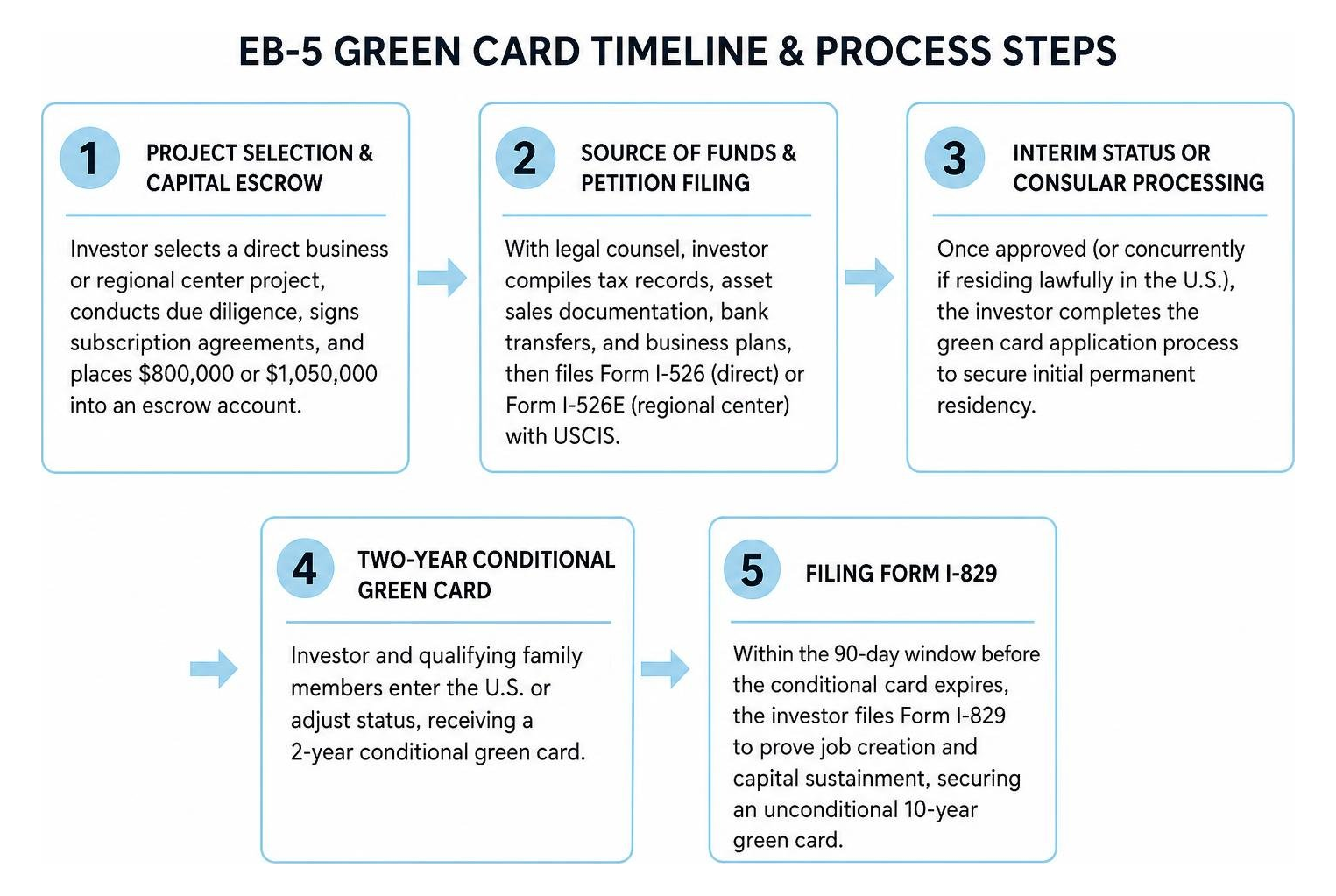
Understanding each phase of this permanent residency process ensures investors maintain compliance and avoid common procedural missteps.
How an investor transitions to conditional residency depends on their physical location and visa availability:
Upon successful adjustment of status or consular admission, the investor and their family receive a conditional green card valid for two years. Conditional status confers identical rights to ordinary permanent residency—including unrestricted employment, domestic study, and international travel—but it carries an expiration date.
During the 90-day window immediately preceding the second anniversary of conditional green card issuance, the investor must file Form I-829 (Petition by Investor to Remove Conditions on Permanent Resident Status). To secure approval, the petition must prove that:
Upon approval of Form I-829, conditions are removed, and USCIS issues standard 10-year unconditional Permanent Resident Cards (Form I-551). Five years after the date initial conditional residency was granted (provided physical presence and continuous residence rules are satisfied), the investor and their family become eligible to apply for U.S. citizenship through naturalization.
Capital investment immigration involves long-term strategic decisions regarding family planning, legal structures, and financial exposure. Securing immigration for individuals and families through the EB-5 program requires weighing numerical visa limits against capital risks and alternative international visa frameworks under clear u s immigration legal guidance.
The U.S. Immigration and Nationality Act imposes a strict statutory ceiling limiting any single country of birth to no more than 7% of total employment-based immigrant visas in a fiscal year. For high-demand jurisdictions—most notably mainland China and India—demand routinely exceeds the annual statutory allocation, causing significant visa backlogs (retrogression) in unreserved categories.
To resolve this issue, the 2022 RIA established three reserved (set-aside) visa categories exempt from standard backlogs:
Applicants from retrogressed countries who invest in projects qualifying under these set-aside allocations can bypass traditional unreserved waiting lines, enabling expedited processing and faster concurrent adjustment of status.
While the EB-5 program is effective, it is not the only option for high-net-worth individuals and accomplished professionals:
When evaluating green card applications and employment-related work visas, investors frequently encounter complex procedural questions:
Processing times vary based on project type and country of chargeability. Form I-526E adjudication generally takes between 4 and 28 months, with rural set-aside projects receiving statutory priority processing from USCIS. For investors inside the U.S. utilizing concurrent filing, interim work permits (EADs) are often adjudicated within 3 to 6 months. From initial capital investment to the final removal of conditions via Form I-829, the full pathway typically spans 4 to 7 years.
Yes. A single qualifying EB-5 investment covers the principal investor, their legally married spouse (including same-sex spouses under equal protection principles), and all unmarried biological or legally adopted children under the age of 21. Derivative family members receive their own conditional and permanent green cards without requiring additional capital investments. This derivative status provides immediate domestic educational benefits, including eligibility for in-state university tuition rates across public U.S. colleges.
If an enterprise fails to generate the requisite 10 full-time jobs or collapses before the 2-year conditional period concludes, USCIS will deny Form I-829, leading to the termination of conditional permanent resident status. To protect against this risk, investors must perform thorough upfront due diligence: evaluating the track record of the regional center, confirming developer equity exposure, verifying reasonable economic job-creation buffers (aiming for 20–30% surplus jobs above the 10-job requirement), and understanding capital redeployment provisions.
The EB-5 Immigrant Investor Program offers a direct route to permanent residency in the United States, unlocking personal, educational, and commercial opportunities for global investors and their families. However, the path requires meticulous legal strategy—from structuring lawful source-of-funds documentation to selecting compliant TEA projects and navigating post-RIA regulatory standards.
At The Nemecek Firm, Ltd., we represent individuals, entrepreneurs, and families navigating complex immigration pathways. Located in Columbus, Ohio, our legal team provides transparent, high-quality advocacy tailored to your unique financial and immigration goals.
If you are exploring permanent residency through capital investment, schedule an immigration case consultation with an experienced immigration lawyer for green card today to build your EB-5 roadmap with clarity and confidence.
