

Hiring an immigration lawyer for deportation defense is the single most important step you can take when facing removal proceedings. Studies and legal advocates consistently confirm that legal representation is the top factor in whether someone wins or loses their case in immigration court.
Here’s what a deportation defense lawyer does for you:
Deportation — now formally called removal under U.S. immigration law — is a civil process, not a criminal one. But the consequences are just as serious. You could be separated from your family, barred from returning for years, and forced to leave a life you’ve built here.
The government will have a trained attorney arguing for your removal. You are not provided one.
That gap matters enormously.
I’m Julie Nemecek, and in this guide I’ll walk you through exactly how deportation defense works, what your options are, and how the right legal strategy can change your outcome.
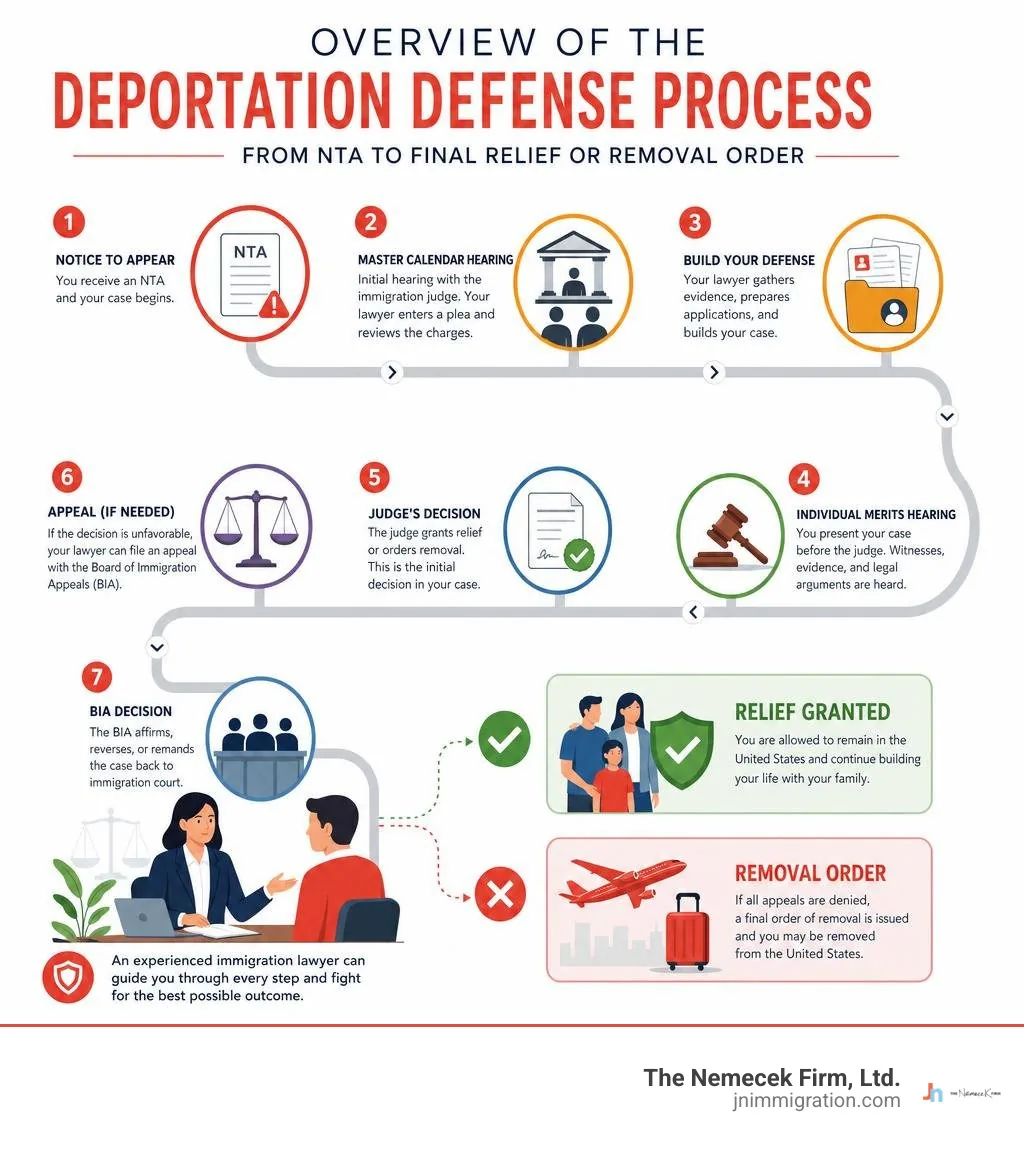
When the U.S. government decides that a noncitizen should not be allowed to remain in the country, it initiates what is formally known as “removal proceedings.” While many people still refer to this as deportation, the legal system uses the term removal defense to describe the process of fighting these actions in court.
Removal defense is a highly specialized area of law. Unlike criminal court, where a defendant is accused of violating penal laws, immigration court is a civil administrative process governed by the Department of Justice (DOJ). However, even though it is technically civil, the stakes could not be higher. If the government succeeds, you face banishment from your home, separation from your loved ones, and the loss of your livelihood.
Anyone who is not a U.S. citizen can potentially find themselves in removal proceedings. This includes:
In many cases, individuals are placed into proceedings after being taken into ICE custody, while others remain free but must attend scheduled court dates. If you or a loved one is facing this stressful situation, exploring your legal options is the first step toward finding peace of mind. We invite you to learn more about how we can support you by reviewing the services we offer.
A common misconception is that obtaining a green card makes you completely safe from deportation. Unfortunately, lawful permanent residence is a privilege under U.S. law, not an absolute, permanent right. A green card holder can absolutely be placed in removal proceedings and deported under several sections of the Immigration and Nationality Act (INA), specifically INA § 237(a).
The most common triggers that strip a green card holder of their status and land them in immigration court include:
Furthermore, the legal landscape for green card holders traveling abroad has become increasingly complex. Under the Supreme Court’s landmark 6-3 decision in Blanche v. Lau (issued on June 23, 2026), a returning Lawful Permanent Resident (LPR) who has pending criminal charges can be treated by border officers as an “applicant for admission.” This means that upon re-entry to the U.S., the government can treat you as if you are applying for entry for the very first time, shifting the burden of proof and making you vulnerable to detention and removal even before your criminal case is fully resolved.
Immigration court cases are handled by the Executive Office for Immigration Review (EOIR), an agency within the U.S. Department of Justice. Because of a massive nationwide court backlog, the timeline for these cases can vary wildly depending on whether you are detained or non-detained.
For individuals who are not in ICE custody, the process is a marathon. It routinely takes two to five years (and sometimes up to six years) from the initial hearing to a final individual merits decision. Conversely, for those who are detained, the process is an absolute sprint, often wrapping up in 30 to 120 days.
| Case Type | Typical Timeline | Speed of Proceedings | Access to Evidence/Counsel |
|---|---|---|---|
| Detained Case | 30 to 120 days | Extremely fast (accelerated docket) | Highly restricted; difficult to gather documents |
| Non-Detained Case | 2 to 6 years | Slow (due to massive EOIR backlogs) | Easier to gather records, secure experts, and consult counsel |
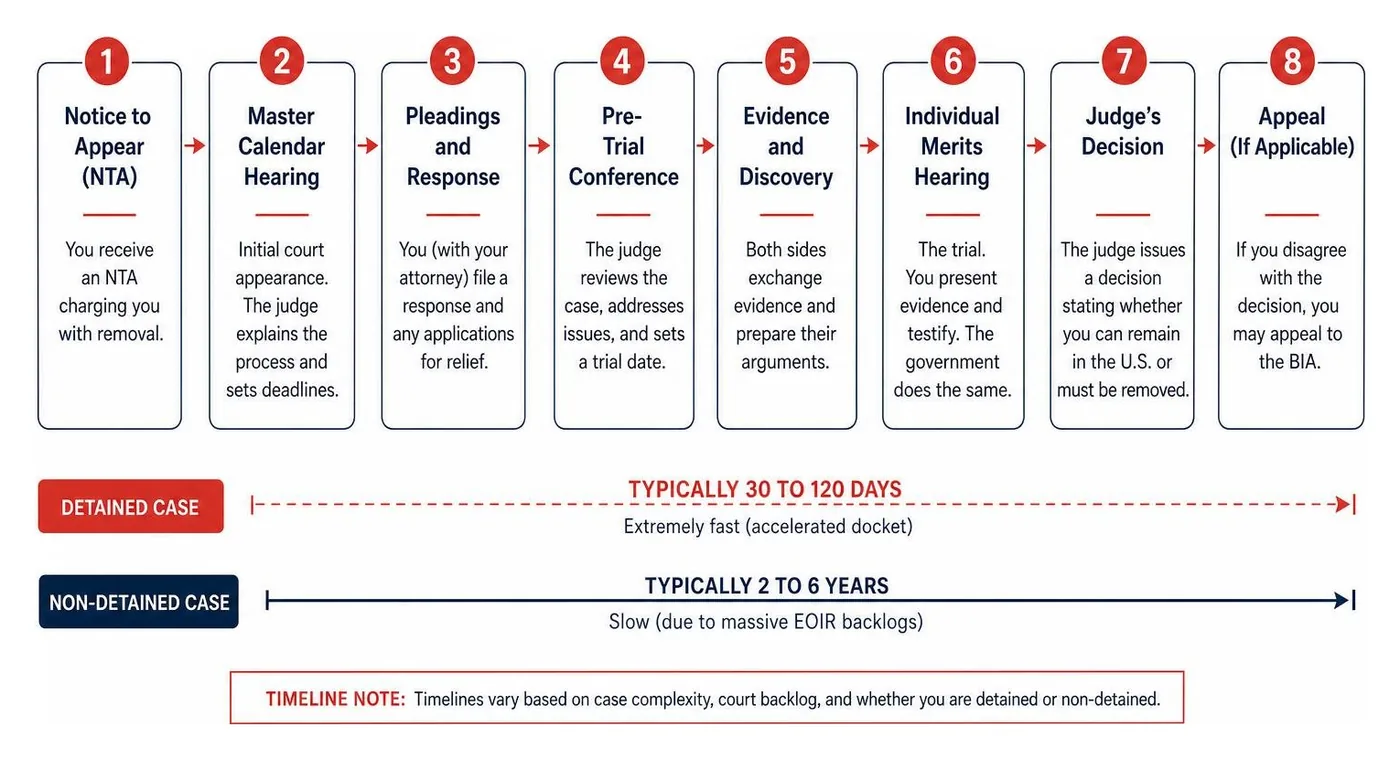
The removal process officially begins when you receive a document called a Notice to Appear (NTA). This is the government’s charging document. It outlines the factual allegations against you (such as your date of entry and your current immigration status) and lists the legal reasons why the government believes you should be removed.
The moment you receive an NTA, you must take immediate, strategic action:
Your journey through the EOIR court system will involve two entirely different types of hearings:
This is a brief, preliminary hearing. Think of it as an arraignment or a scheduling conference. The courtroom will be packed with dozens of other immigrants. During the MCH, the judge will ask if you have an attorney, read the charges on your NTA, and ask how you plead to those charges. Your immigration lawyer for deportation defense will use this hearing to enter pleadings, challenge any errors in the government’s charges, and identify which forms of relief you plan to apply for.
This is your actual trial. It is a private, formal proceeding where the focus is entirely on your case. During this hearing, your attorney will present physical evidence, call witnesses (including family members or country conditions experts), and cross-examine the government’s trial attorney. Because the judge will make a final decision at the end of this hearing, meticulous preparation is key. To understand how we build these defenses, you can read more about immigration court defense strategies.
If a loved one is arrested by ICE, securing their release from detention is the absolute highest priority. Being detained makes it incredibly difficult to gather documents, meet with counsel, and prepare a strong defense.
Many detained individuals are eligible for an immigration bond. A bond is a financial guarantee paid to the government to ensure that the individual will attend all future court hearings if released. Bond amounts in immigration court are highly discretionary and typically range from $1,500 to $25,000 or more, depending on factors like flight risk, community ties, and criminal history.
An experienced deportation defense attorney can request a separate bond hearing before an immigration judge. Even if the individual is held in a remote facility, such as the Stewart Detention Center, we can leverage remote technology like Webex hearings to represent them efficiently, present a compelling bond package, and argue for the lowest possible bond amount.
Facing removal does not mean you have run out of options. U.S. immigration law provides several pathways—known as statutory relief—that allow you to stop deportation and, in many cases, obtain a green card. Additionally, we can advocate for “prosecutorial discretion” or a “stay of removal,” asking the government to deprioritize your case or temporarily halt an order of deportation due to humanitarian reasons.
Cancellation of Removal is one of the most powerful defenses available, but it is also one of the most difficult to win. There are two types:
Winning non-LPR cancellation is highly competitive because Congress has placed a strict statutory limit of only 4,000 cancellation grants per fiscal year nationwide. Because of this cap, presenting an airtight case backed by extensive documentary evidence is vital.
If you fear returning to your home country because you will face persecution or torture, you can apply for protection. There are three primary forms of fear-based relief:
At The Nemecek Firm, Ltd., we passionately represent LGBT individuals and couples. Asylum claims based on sexual orientation or gender identity are highly complex and require a deep, empathetic understanding of both local country conditions and evolving U.S. asylum law. We work tirelessly to compile the expert testimony and personal narratives required to win these life-saving cases.
During removal proceedings, an experienced attorney will look at your entire life and family history to see if you qualify for other, non-court-based pathways to legal status:
To explore which of these pathways might apply to your unique situation, we recommend scheduling an immigration case consultation with our team.
If the immigration judge determines that you do not qualify for any form of relief, your attorney may ask for “voluntary departure” instead of a formal removal order.
While both options mean you must leave the United States, they carry vastly different legal consequences:
The intersection of criminal law and immigration law is known as “crimmigration.” It is one of the most complex and unforgiving areas of the legal system. A single state-level misdemeanor conviction can sometimes be classified as an “aggravated felony” under federal immigration law, leading to mandatory detention and automatic deportation.
Common criminal categories that trigger deportation include:
If you have a past conviction that is threatening your immigration status, we can explore post-conviction relief options. This includes filing a Padilla claim, which argues that your original criminal defense attorney failed to properly advise you of the immigration consequences of your guilty plea, potentially allowing us to vacate the conviction and eliminate the ground for deportation.
The absolute hardest truth about immigration court is that the government will not provide you with a lawyer. While the U.S. Constitution guarantees a free public defender to anyone accused of a crime, immigration court is civil, meaning you only have the right to counsel at your own expense.
According to national TRAC immigration data, having a lawyer is the single most influential factor in whether you win your case. Immigrants with legal representation are up to five times more likely to secure relief from deportation compared to those who attempt to represent themselves against a trained government prosecutor.

When your future in the United States is on the line, you should not rely on generic legal advice or try to navigate this adversarial system alone. We encourage you to get professional immigration legal advice as early in the process as possible.
If ICE agents come to your home, do not open the door unless they can slide a warrant signed by a court judge under the door. A standard administrative warrant signed by an ICE officer does not give them the legal right to enter your home without your permission.
You have the right to remain silent, and you have the right to speak to an attorney. Do not sign any documents without consulting a lawyer first, and contact an emergency contact or attorney immediately.
Yes, in many cases you can. While simply being in removal proceedings does not automatically grant you the right to work, filing certain applications for relief—such as asylum or cancellation of removal—allows you to apply for an Employment Authorization Document (EAD). Once your relief application has been pending for the legally required period, your attorney can help you file for your work permit.
If the immigration judge issues an unfavorable decision, you have exactly 30 calendar days from the date of the decision to file a Notice of Appeal (Form EOIR-26) with the Board of Immigration Appeals (BIA). This deadline is strict and unforgiving. If you miss it, the judge’s decision becomes a final order of removal.
Additionally, if new, previously unavailable evidence comes to light after your case has concluded, you may have up to 90 days to file a motion to reopen your case.
Facing deportation is undoubtedly one of the most frightening experiences an individual or family can go through. But you do not have to fight this battle alone.
At The Nemecek Firm, Ltd., we are proud to serve as a trusted columbus immigration lawyer, offering high-quality, compassionate, and affordable representation to individuals throughout Columbus and across Ohio. Whether you need a dedicated immigration attorney columbus ohio to represent you in court, are seeking an ohio immigration lawyer who specializes in complex employment-based immigration, or need sensitive, passionate support for LGBT immigration matters, we are here to stand by your side.

Every day matters when you are fighting to stay in the United States. Take control of your future and protect your family by taking action today. Schedule an immigration case consultation today to discuss your case and map out your defense strategy.
To start your journey with us, please visit our contact page.
Get our immigration articles first in Google