

An immigration asylum attorney is essential for anyone seeking protection in the U.S. from persecution in their home country. These legal experts build your case, prepare all documents like Form I-589, represent you in interviews and court, and significantly increase your chances of approval. Unrepresented applicants in defensive cases have only a 10% success rate.
The U.S. asylum system is complex. You must file within one year of arrival and prove a “well-founded fear” of persecution based on race, religion, nationality, political opinion, or membership in a particular social group (including LGBTQ individuals).
The stakes are incredibly high, as a denial can lead to deportation. The process involves strict deadlines, difficult evidence gathering, and precise legal standards. As one attorney reflected, asylum cases are deeply personal—they’re about life and safety, not just immigration status.
This guide will explain how to find and work with a top immigration asylum attorney to give you the best chance at safety in the United States.
Related content about Immigration asylum attorney:
Asylum is legal protection to stay in the United States if you have suffered persecution or have a well-founded fear you will if you return home. This fear must be objectively reasonable, not just a feeling. When you apply for asylum, you are asking the U.S. to recognize you as a refugee—someone unable or unwilling to return to their country due to this fear.
Persecution is serious, targeted harm, such as violence, torture, unlawful detention, or credible threats. It is not just general hardship or economic struggle. The harm must be inflicted by your government or by groups your government cannot or will not control. An immigration asylum attorney is vital for proving you cannot return home safely and meeting these strict legal standards.
More info about Asylum and Refugee Services.
Your fear of persecution must be linked to at least one of five specific reasons, known as “protected grounds”:
An experienced attorney can help identify which ground best fits your situation and build the strongest legal argument.
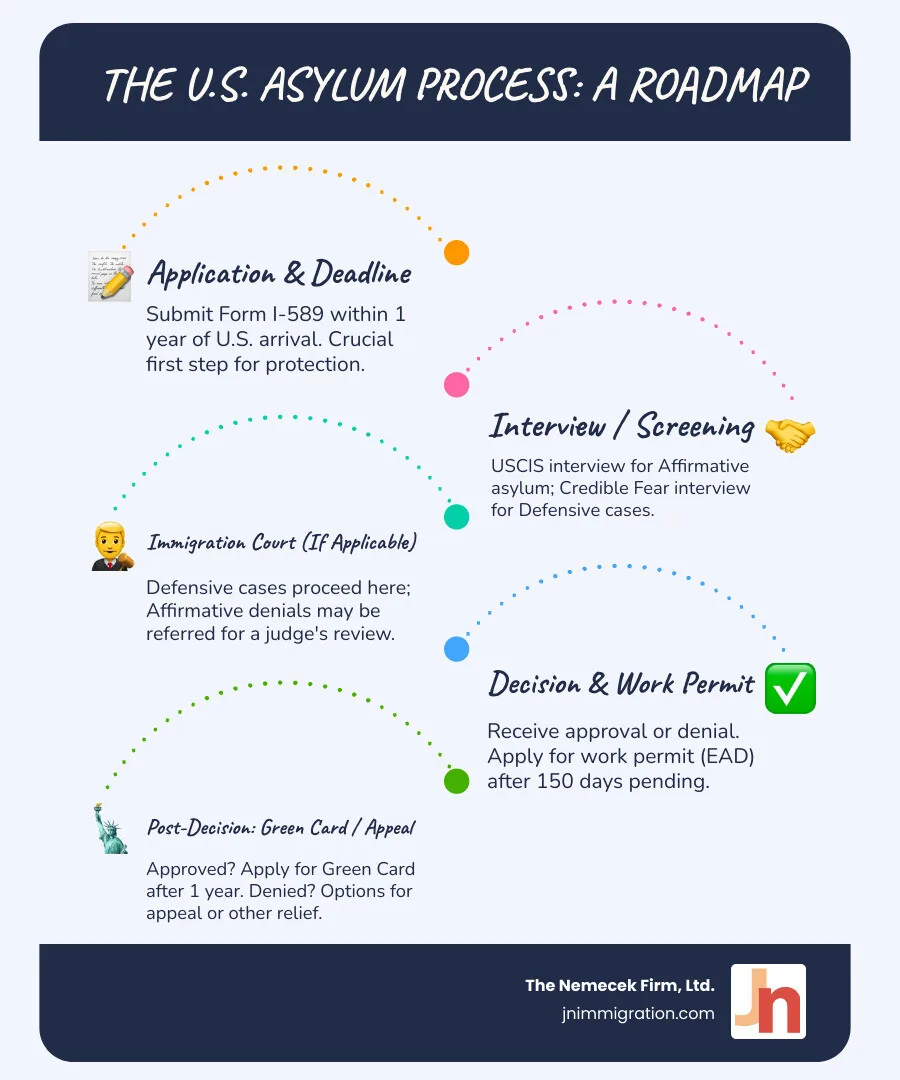
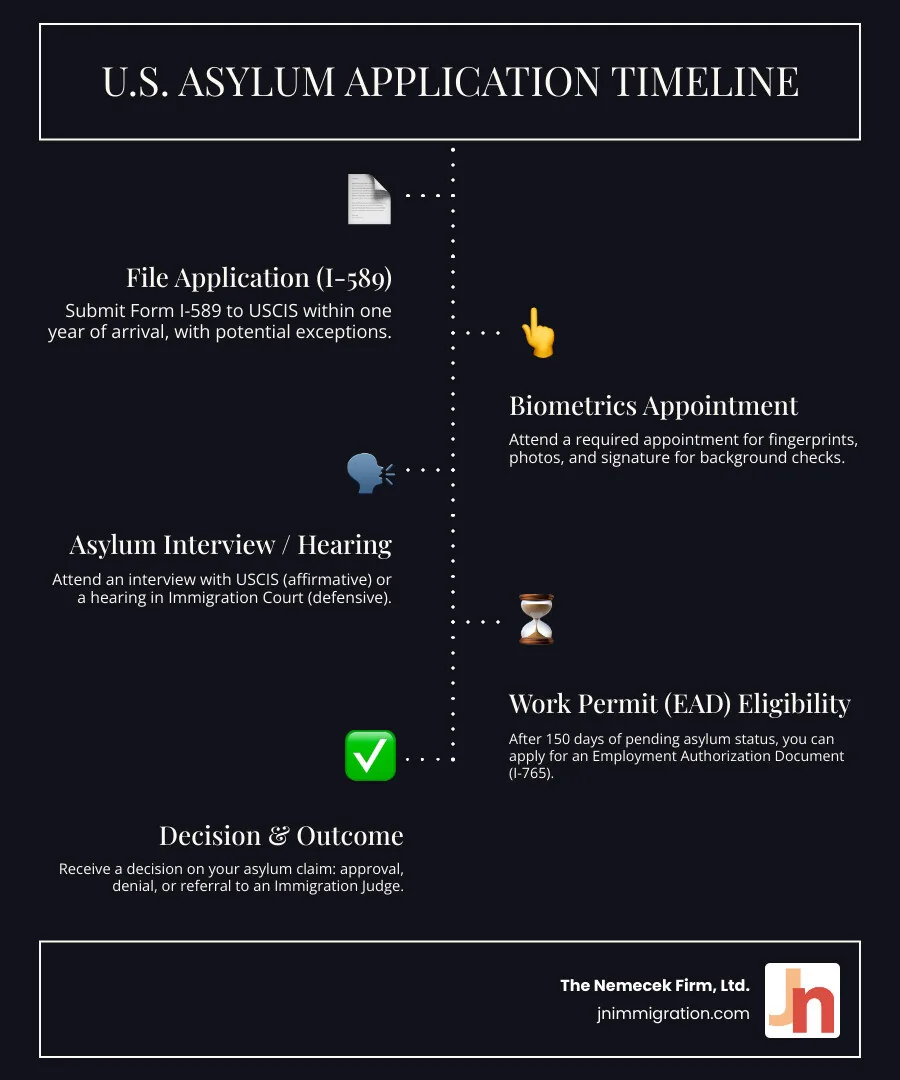
There are two distinct routes for seeking asylum in the U.S. One is a proactive request for protection (affirmative), while the other is a defense against deportation (defensive). Both begin with Form I-589, Application for Asylum, which must generally be filed within one year of your arrival for affirmative cases.

The main difference is where your case is decided: with a USCIS asylum officer or an Immigration Judge. This determines the atmosphere, timeline, and stress level of the process. Individuals apprehended at the border may first have a credible fear interview, a screening that can lead to the defensive asylum process.
Affirmative asylum is for those already in the U.S. who are not in removal proceedings. You can file regardless of your current immigration status. The process involves a non-adversarial interview with a trained USCIS asylum officer who seeks to understand your story.
If the officer does not approve your case and you lack legal status, it is referred to an Immigration Judge, giving you a second chance in court. After your application has been pending for 150 days, you can apply for a work authorization (EAD), which is a critical lifeline.
Defensive asylum is used as a defense when you are already in removal proceedings. This happens in a formal, adversarial court hearing before an Immigration Judge. A government (ICE) attorney will argue against your claim and may cross-examine you.
The stakes are higher: if the judge denies your claim, you could be ordered removed from the U.S. This is why legal representation is so critical. Statistics show unrepresented applicants in defensive cases have only a 10% approval rate. An Immigration asylum attorney dramatically improves these odds by navigating court rules and building a persuasive case.
Here’s how the two paths compare:
| Feature | Affirmative Asylum | Defensive Asylum |
|---|---|---|
| Who Files | Individual in the U.S., not in removal proceedings | Individual in removal proceedings |
| Where to File | USCIS | Immigration Court |
| Interview/Hearing Style | Non-adversarial interview with Asylum Officer | Adversarial hearing with Judge and DHS attorney |
| Outcome if Denied | Case referred to Immigration Court (second chance) | Potential order of removal |
Understanding these differences is key to preparing for what lies ahead and highlights why expert legal guidance is invaluable.
The U.S. asylum system is a labyrinth of complex laws and strict deadlines. For someone fleeing persecution, navigating it alone is nearly impossible. An experienced immigration asylum attorney is often the difference between safety and deportation.

From the start, an attorney acts as your strategist and advocate. They begin by developing a case strategy, identifying the strongest legal arguments for your claim based on the five protected grounds. This involves several key actions:
Statistics show that unrepresented applicants in defensive asylum cases have only a 10% success rate. With an attorney, those odds improve dramatically. Immigration law is constantly changing, and only a specialist can stay current on the policies and court decisions that affect your case.
An attorney ensures all strict deadlines are met, preventing your case from being dismissed on a technicality. Beyond the legal work, they provide peace of mind, allowing you to focus on your well-being while they handle the complexities. Given that asylum cases are about life and safety, skilled legal representation is a necessity, not a luxury.
More info on why you need an Immigration Lawyer for Asylum.
Receiving a decision on your asylum application is a pivotal moment. Understanding the next steps, whether your case is approved or denied, is crucial.
An approval is a life-changing event that grants you safety and a future in the U.S. As an asylee, you can live and work here indefinitely. Key benefits include:

If your application is denied, you may still have options like Withholding of Removal or protection under the Convention Against Torture (CAT). You can also appeal the decision. An Immigration asylum attorney is invaluable for navigating these complex post-denial options.
Vulnerability can attract scammers. It’s critical to find legitimate legal help. Beware of “notario” fraud; in the U.S., a notary public is not an attorney and cannot provide legal advice.
To protect yourself:
While you must generally file for asylum within one year of arriving in the U.S., there are exceptions to the rule. You may still be eligible if you can demonstrate either changed circumstances (like a new anti-LGBTQ law in your home country) or extraordinary circumstances that prevented you from filing on time (like severe illness or trauma).
Proving these exceptions requires strong evidence and legal arguments. An experienced Immigration asylum attorney is critical for evaluating your eligibility for an exception and building a compelling case.
Yes. You can apply for a work permit, or Employment Authorization Document (EAD), by filing Form I-765. However, you must wait 150 days after your complete asylum application is filed. This waiting period is known as the “EAD clock.” Any delays you cause in your case, such as rescheduling an interview, can stop the clock. Once issued, your EAD can be renewed as long as your asylum case is pending.
The U.S. system, while based on international refugee principles, has unique features. Key differences include:
Understanding these U.S.-specific requirements is essential. An expert Immigration asylum attorney can steer these complexities for you.
The path to asylum in the United States is complex, but it offers the profound chance to live without fear. Navigating the legal requirements, deadlines, and evidence standards is a monumental task.
As statistics show, attempting this journey alone is risky, with unrepresented applicants in defensive cases facing a mere 10% approval rate. A skilled Immigration asylum attorney dramatically improves your chances of success. They are not just legal experts; they are advocates who transform your story into a compelling legal case, providing guidance and hope during a stressful time.
At The Nemecek Firm, Ltd., based in Columbus, Ohio, we provide high-quality, affordable immigration representation across the U.S. We understand that asylum cases are about human lives. Attorney Nemecek offers recognized expertise, including specialized knowledge in LGBT asylum cases, where understanding the nuances of “particular social group” claims is critical.
Seeking asylum takes immense courage. You don’t have to face this journey alone. If you need guidance with your asylum application, we are here to help you present your case with the strength it deserves.
Contact us for a consultation on your Asylum case. We’re ready to stand with you.
Get our immigration articles first in Google