

Step-by-Step Guide to Choosing an Employment Based Immigration Attorney

1 Views

0 Comments

June 12, 2026

Step-by-Step Guide to Choosing an Employment Based Immigration Attorney

When You Need an Employment Based Immigration Attorney: What to Know First

Finding the right employment based immigration attorney can make or break your ability to work legally in the United States — or to hire the global talent your business needs.

Here is a quick answer to what most people are looking for:

What does an employment based immigration attorney do?

  1. Evaluates your eligibility for temporary work visas (H-1B, L-1, O-1, TN, E-2) or permanent green cards (EB-1 through EB-5)
  2. Prepares and files petitions with USCIS and the Department of Labor on your behalf
  3. Manages compliance risks including I-9 audits, LCA requirements, and worksite enforcement
  4. Responds to government requests such as Requests for Evidence (RFEs) and Notices of Intent to Deny (NOIDs)
  5. Guides you through adjustment of status or consular processing until your case is resolved
  6. Advises on self-petition options like the National Interest Waiver (NIW) if you do not have an employer sponsor

U.S. immigration law is federal, complex, and constantly shifting. USCIS issues approximately 140,000 employment-based green cards per year, spread across five preference categories — and competition for those slots is intense. One missed deadline or incomplete filing can delay your case by months or even years.

Whether you are an employer trying to sponsor a skilled foreign worker, a professional seeking permanent residency on your own, or someone navigating a visa transition, the stakes are high.

The right attorney does not just fill out forms. They build a case that anticipates every objection before it arrives.
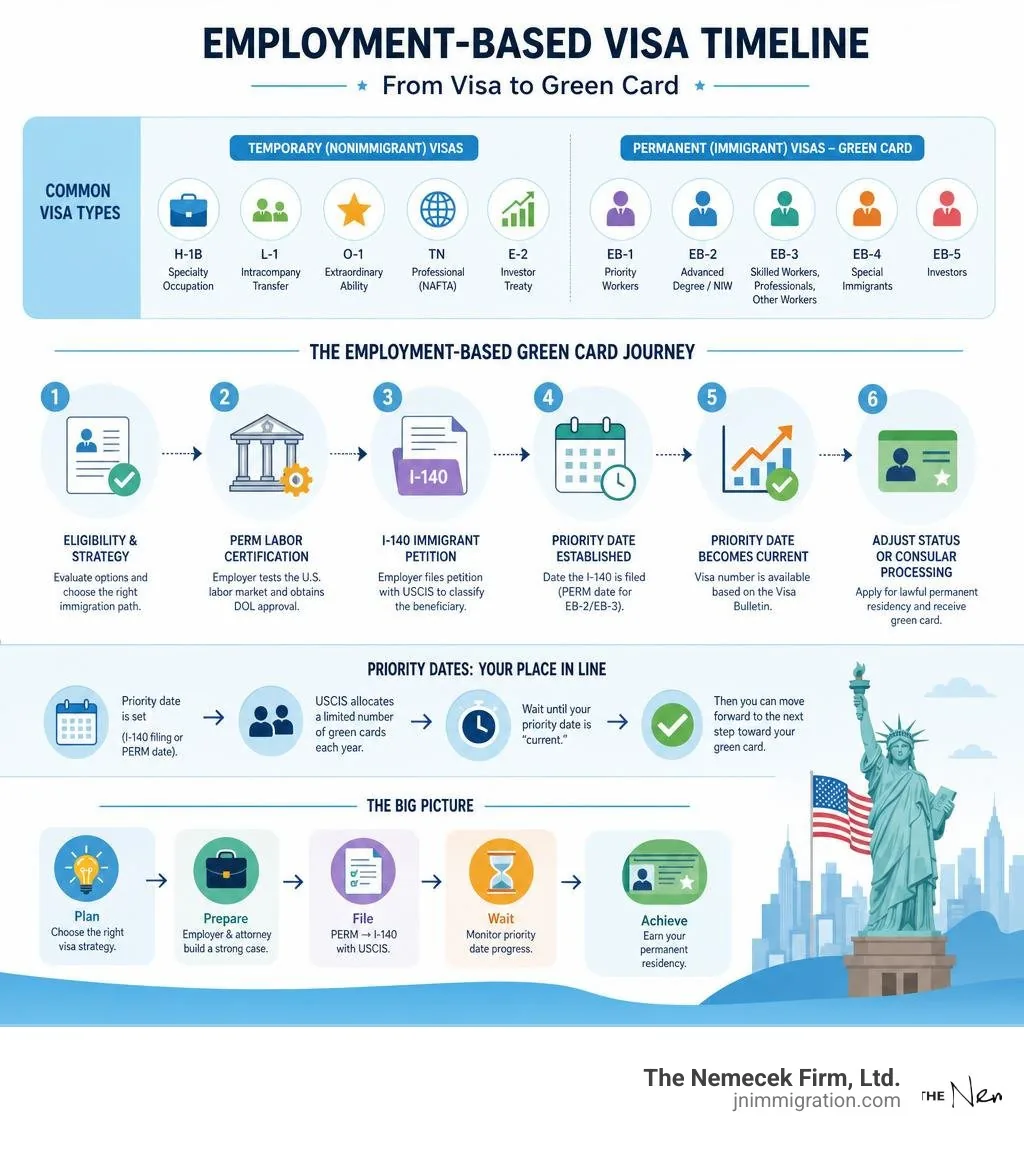
Employment-based visa timeline infographic: visa types, PERM, I-140, priority dates, green card steps infographic

Understanding the Landscape: Temporary Visas vs. Permanent Green Cards

Before you begin interviewing legal teams, it is vital to understand the basic pathways available. United States immigration is broadly divided into two pathways: nonimmigrant (temporary) visas and immigrant (permanent residency or “green card”) pathways.

Choosing the wrong pathway can lead to unnecessary delays, wasted application fees, or even status violations. An experienced employment based immigration attorney can help you evaluate which option aligns with your professional timeline and business objectives. Through our Employment Based Immigration Services, we assist clients in mapping out these pathways clearly.

Feature Temporary Nonimmigrant Visas Permanent Green Cards (Immigrant Visas)
Primary Intent Temporary stay in the U.S. for a specific period Lawful permanent residency with a path to citizenship
Sponsorship Usually requires an employer (except certain investor/extraordinary categories) Often requires employer sponsorship, but self-petitions are possible (NIW, EB-1A)
Duration Limited (e.g., 3 to 6 years, depending on the visa category) Indefinite (renewed every 10 years)
Path to Citizenship None directly (though “dual intent” visas allow transition to green cards) Direct path to naturalization (typically after 5 years as a permanent resident)
Labor Certification Generally not required (except for H-2A/H-2B and certain specialty cases) Frequently required (PERM labor certification for EB-2 and EB-3)

Whether you need immediate assistance with temporary Work Visas or are looking to build a long-term retention plan, we can guide you through the pros and cons of each choice.

Temporary Nonimmigrant Work Visas

Temporary work visas allow foreign nationals to enter the United States to work for a specific employer for a set duration. These visas are excellent for immediate business needs, though they do not automatically lead to permanent residency. Here are the most common temporary options:

  • H-1B Visa (Specialty Occupations): This is the most popular visa for professional workers in fields like technology, engineering, and finance. It requires a bachelor’s degree or its equivalent in a specific specialty. Because of the high demand, USCIS uses an annual lottery system. Navigating this lottery and subsequent filing requires professional H1-B Visa Assistance to ensure compliance.
  • L-1 Visas (Intracompany Transferees): Designed for multinational companies transferring employees to a U.S. office. L-1A managers and executives can stay for up to 7 years, while L-1B employees with specialized knowledge can stay for up to 5 years.
  • O-1 Visa (Extraordinary Ability): For individuals who possess extraordinary ability in the sciences, arts, education, business, or athletics. It is initially valid for up to 3 years and can be extended indefinitely.
  • E-2 Investor Visa: For entrepreneurs and investors from treaty countries who make a substantial capital investment in a U.S. business.
  • TN Visa: Created under the USMCA agreement, this visa allows citizens of Canada and Mexico to work in the U.S. in specific professional roles.

Permanent Green Card Categories (EB-1 to EB-5)

If your goal is permanent residency, you must navigate the employment-based (EB) preference categories. Sponsoring an employee for a green card provides long-term stability and is one of the most powerful recruitment tools available. Explore these Green Card Sponsorship Opportunities to secure your top talent:

  • EB-1 (Priority Workers): This first-preference category is reserved for three groups: individuals with extraordinary ability in their fields, outstanding professors and researchers, and multinational managers or executives. A major benefit of the EB-1 extraordinary ability visa is that it does not require a job offer or labor certification, allowing for self-petitioning.
  • EB-2 (Advanced Degree or Exceptional Ability): For professionals holding an advanced degree (or a bachelor’s degree plus five years of progressive work experience) or those with exceptional ability in the sciences, arts, or business. This category typically requires an employer to obtain a labor certification.
  • EB-3 (Skilled, Professional, and Other Workers): This category covers skilled workers (requiring at least two years of training or experience), professionals (requiring a U.S. bachelor’s degree or foreign equivalent), and unskilled workers. Like EB-2, it requires a labor certification.
  • EB-4 (Special Immigrants): This category covers specific groups, including religious workers, certain broadcasters, and retired employees of international organizations.
  • EB-5 (Immigrant Investors): For foreign investors who invest a significant amount of capital into a new commercial enterprise that creates or preserves at least 10 full-time jobs for U.S. workers within two years.

Self-Petitioning and the National Interest Waiver (NIW)

What if you do not have a U.S. employer to sponsor you? You may still have a path to permanent residency. Under the EB-2 category, you can apply for a National Interest Waiver (NIW). This allows you to self-petition, bypassing both the employer sponsorship requirement and the lengthy labor certification process.

To qualify for an EB-2 NIW, your petition must satisfy the three-pronged Dhanasar test:

  1. The proposed endeavor must have both substantial merit and national importance.
  2. You must be well-positioned to advance the proposed endeavor.
  3. On balance, it must be beneficial to the United States to waive the job offer and labor certification requirements.

This is an exceptional option for researchers, entrepreneurs, and highly skilled specialists. However, USCIS has increased scrutiny on these petitions, sometimes applying a strict “Final Merits Analysis” to exceptional ability filings. Working with an experienced attorney is essential to craft a persuasive, evidence-backed narrative that stands up to federal scrutiny.

The Step-by-Step Employment-Based Immigration Process

legal professional reviewing immigration documents

Understanding the Employment Based Immigration Process is crucial for managing timelines and setting expectations. The journey from a job offer to holding a physical green card involves multiple federal agencies, including the Department of Labor (DOL), USCIS, and the Department of State (DOS).

For most EB-2 and EB-3 green card petitions, the journey begins with the PERM labor certification program. Administered by the Department of Labor, this step is designed to protect the U.S. labor market.

Through the Labor Certification Program, the employer must prove to the government that:

  1. There are not enough qualified, willing, and available U.S. workers to fill the position.
  2. Hiring the foreign national will not adversely affect the wages and working conditions of similarly employed U.S. workers.

This process requires the employer to request a prevailing wage determination from the DOL, conduct a rigorous, highly regulated recruitment process (including posting advertisements in local newspapers and on state job boards), and evaluate all U.S. applicants in good faith. If any qualified U.S. worker applies, the PERM application cannot be filed. Because the DOL strictly audits these campaigns, even a minor procedural error can force you to restart the entire recruitment process from scratch.

From Job Offer to Adjustment of Status or Consular Processing

Once the labor certification is approved, the official immigration petition begins. Here is how the rest of the timeline unfolds:

  1. Filing the Immigrant Petition (Form I-140): The employer files Form I-140 with USCIS to demonstrate that the foreign worker meets the minimum requirements of the job and that the employer has the financial ability to pay the offered wage.
  2. Monitoring Priority Dates: Every applicant is assigned a “priority date” (the date the PERM or I-140 was filed). Because of annual limits on green cards, applicants must monitor the DOS Visa Bulletin. You can only take the final step when your priority date becomes “current.”
  3. The Final Step — Adjustment of Status vs. Consular Processing:
    • Adjustment of Status (Form I-485): If the employee is already lawfully inside the United States, they can file Form I-485 to adjust their status to a permanent resident without leaving the country.
    • Consular Processing: If the employee is currently outside the United States, they must attend an interview at a U.S. Embassy or Consulate in their home country to obtain an immigrant visa before traveling to the U.S.

Why You Need an Experienced Employment Based Immigration Attorney

Immigration law is notoriously unforgiving. The rules are strict, and government filing fees are high. Trying to navigate this landscape alone or relying on generic templates often leads to costly delays.

Partnering with an experienced legal team provides peace of mind. For a deeper look at how legal representation protects your interests, read our guide on 5 Convincing Reasons You Need an Employment Based Immigration Lawyer. From initial eligibility evaluations to complete petition preparation, we ensure your Employment Based Immigration strategy is executed correctly the first time.

Managing Compliance Risks and Worksite Enforcement

For employers, immigration is not just about sponsoring new hires; it is also about maintaining compliance for your existing workforce. Sponsoring foreign nationals exposes businesses to strict federal oversight.

Employer and employee discussing compliance

An immigration attorney helps you manage critical compliance risks, including:

  • I-9 Audits: Every U.S. employer must maintain Form I-9 for all employees. The Department of Homeland Security regularly conducts audits, and errors can result in severe financial penalties.
  • Labor Condition Application (LCA) Compliance: For H-1B petitions, employers must file an LCA certifying that they are paying the required wage. Failure to maintain a public access file can lead to back-pay orders and temporary bans on hiring foreign workers.
  • Fee and Enforcement Shifts: Government filing fees change frequently, and corporate compliance programs must adapt to keep hiring pipelines moving smoothly.

For more information on managing corporate immigration compliance, you can review the comprehensive practices outlined by national legal resources like Duane Morris LLP.

Industry-Specific Considerations for Sponsoring Employers

Different industries face unique regulatory landscapes when it comes to Employment Sponsorship. A cookie-cutter approach simply does not work:

  • Healthcare Workforce: Sponsoring foreign-trained physicians, nurses, and researchers involves navigating specialized licensing requirements, J-1 home-residency waivers, and fast-tracked clinical green cards.
  • Aviation Industry: Pilot recruitment and aviation engineering have unique credentialing standards. Attorneys must craft precise petitions that explain how a pilot’s specific experience meets complex federal guidelines.
  • Tech Startups: Startups often face intense scrutiny regarding their “ability to pay” prevailing wages. We help early-stage companies build creative immigration strategies, utilizing O-1 visas, L-1 transfers, or specialized investor pathways.

Choosing your legal representative is a critical decision. You need an attorney who is not only highly knowledgeable in federal law but also accessible, responsive, and familiar with your local business environment. If you are located in Ohio, working with a team specializing in Employment Based Immigration Columbus Ohio ensures you have local advocates who understand the regional job market and maintain close ties to the community.

Key Criteria for Selecting an Employment Based Immigration Attorney

When evaluating potential firms, look for the following indicators of quality:

  • AILA Membership: Active membership in the American Immigration Lawyers Association (AILA) indicates that the attorney is plugged into the latest legal changes, policy shifts, and agency liaisons.
  • Proven Track Record: Look for a firm with experience handling cases similar to yours, whether that is high-volume H-1B filings, complex PERM recruitment campaigns, or self-petitioned National Interest Waivers.
  • Affordable, Transparent Representation: Immigration processes are expensive. A good firm will provide a clear, upfront fee schedule so you can budget accurately for legal fees and government filing costs.
  • Inclusive Practice: For LGBTQ+ individuals and couples, immigration can introduce unique cross-border challenges. Choose a firm that is openly welcoming and experienced in navigating these specific personal and professional dynamics.
  • External Verifications: Verify credentials through trusted legal directories such as Justia Columbus Immigration Lawyers or review local business directories like Employment Immigration Attorneys in Ohio.

Questions to Ask Your Prospective Employment Based Immigration Attorney

During your initial consultation, do not hesitate to ask direct questions to gauge if the firm is the right fit:

  1. What is your experience with my specific industry or visa category?
  2. How do you structure your fees? Are they flat fees or hourly rates, and what is included?
  3. Who will be my primary point of contact, and what are your communication protocols for updates?
  4. How do you handle unexpected setbacks, such as a Request for Evidence (RFE) or a DOL audit?
  5. What are the realistic processing timelines for my case based on current agency backlogs in June 2026?

Frequently Asked Questions about Employment-Based Visas

What is the annual cap on employment-based green cards?

By law, approximately 140,000 employment-based green cards are available globally each year. This annual limit is divided among the five preference categories (EB-1 through EB-5). Furthermore, no single country can receive more than 7% of the total green cards in a given year. This “per-country limit” is what causes significant backlogs and long waiting periods for applicants from high-demand countries like India and China.

How long can an employee stay on temporary work visas like H-1B or L-1?

  • H-1B Visa: The H-1B is initially valid for up to 3 years and can be extended for a maximum stay of 6 years. However, if an employee has an approved Form I-140 and is waiting for their priority date to become current, their H-1B status can be extended past the 6-year limit in 1-year or 3-year increments.
  • L-1A Visa (Managers/Executives): Maximum stay of 7 years.
  • L-1B Visa (Specialized Knowledge): Maximum stay of 5 years.

Once these limits are reached, the employee must typically reside outside the United States for at least one full year before they can qualify for the status again.

What are the job creation requirements for an EB-5 investor visa?

To qualify for an EB-5 immigrant investor green card, the applicant must demonstrate that their capital investment will create or preserve at least 10 full-time, direct or indirect jobs for qualifying U.S. workers. This job creation must occur within a 2-year period following the investor’s admission to the United States as a conditional permanent resident.

Conclusion

Navigating the U.S. immigration system can feel like trying to solve a puzzle where the rules change halfway through. Whether you are a business looking to hire world-class talent or an individual professional striving to build a life in Ohio, you do not have to walk this path alone.

At The Nemecek Firm, Ltd., located in Columbus, Ohio, we are dedicated to providing high-quality, affordable legal representation. We specialize in employment-based immigration, helping employers and employees secure the visas and green cards they need to succeed. Furthermore, we are proud to passionately serve LGBT individuals and couples, providing compassionate, specialized guidance to navigate the unique challenges that can arise in international relationships.

Let us help you turn your professional goals into reality. Contact us today to explore your options for Employment Based Immigration Columbus Ohio or to learn more about our comprehensive Employment Based Immigration Services. We look forward to partnering with you on your immigration journey.