
An immigration lawyer employment-based helps foreign nationals and U.S. employers steer one of the most complex areas of U.S. immigration law. Whether you’re seeking temporary work authorization or permanent residency through your career, the process involves multiple government agencies, strict deadlines, and detailed documentation requirements.
Quick Answer: What Does an Employment-Based Immigration Lawyer Do?
| Service | How It Helps |
|---|---|
| Visa Category Selection | Identifies the right path among EB-1 through EB-5 immigrant visas or H-1B, L-1, O-1, TN nonimmigrant options |
| PERM Labor Certification | Navigates Department of Labor requirements or secures exceptions like National Interest Waivers |
| Form I-140 & I-485 Filing | Prepares immigrant petitions and adjustment of status applications with proper evidence |
| Compliance Guidance | Ensures employers meet I-9, E-Verify, and prevailing wage requirements |
| Backlog Navigation | Monitors visa bulletins, priority dates, and helps with job portability under changing circumstances |
The U.S. immigration system allocates approximately 140,000 employment-based immigrant visas each year across five preference categories. But getting one of those visas isn’t simple. You’re dealing with USCIS procedures, Department of Labor certifications, State Department consular processing, and constantly changing policies.
Many people face challenges they didn’t expect. The H-1B lottery happens once a year with registration periods lasting just weeks. Labor certification through the PERM process can take months and requires proving no qualified U.S. workers are available. Priority dates can retrogress, leaving approved petitions in limbo for years.
An experienced employment-based immigration lawyer knows how to structure your case from the start. They understand which visa category fits your qualifications, when you can skip labor certification through a National Interest Waiver, and how to document extraordinary ability or advanced degrees properly. They also help employers stay compliant and avoid costly penalties.
For LGBT individuals and couples, employment-based immigration offers a pathway that doesn’t rely on family relationships. It can provide stability and independence regardless of marital status or family structure.
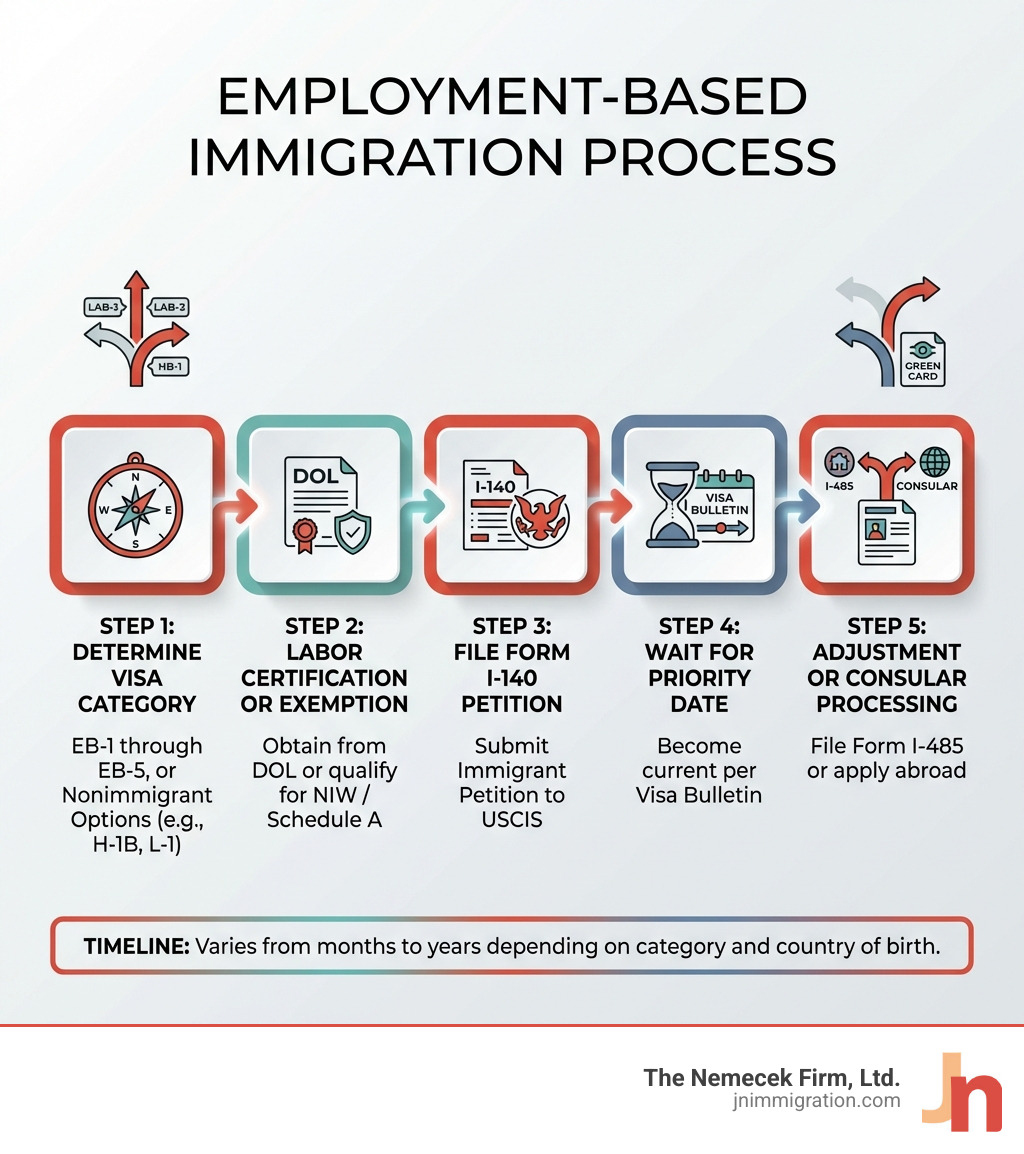
When you decide to pursue a career in the United States, the first hurdle is figuring out which “alphabet soup” visa category fits your life. At The Nemecek Firm, Ltd., we see many brilliant professionals who aren’t sure if they are “extraordinary” enough for an EB-1 or if their Master’s degree automatically qualifies them for an EB-2. This is where an immigration lawyer employment-based becomes your most valuable strategist.
The U.S. government divides permanent employment visas into five preference categories, each with its own set of strict rules:
| Category | Typical Requirement | Labor Certification (PERM)? |
|---|---|---|
| EB-1 | Extraordinary ability, Executives | No |
| EB-2 | Master’s degree or equivalent | Yes (unless NIW/Schedule A) |
| EB-3 | Bachelor’s or skilled labor | Yes |
| EB-4 | Special circumstances (Religious, etc.) | No |
| EB-5 | $800k+ Investment | No |
Choosing the wrong category can lead to years of unnecessary waiting or a flat-out denial. We provide employment-based immigration services that analyze your unique background to ensure we aim for the most efficient path possible.
For most EB-2 and EB-3 cases, the process starts not with USCIS, but with the Department of Labor (DOL). This is the “PERM” process (Program Electronic Review Management). It requires the employer to test the U.S. labor market to prove there are no able, willing, qualified, and available U.S. workers for the position.
This process is notoriously rigid. From using the DOL’s FLAG system to filing the Form ETA-9089, one tiny clerical error can tank the entire application. We help employers steer these legal requirements for labor certification to ensure the recruitment process is handled correctly.
However, a great immigration lawyer employment-based also knows when you can skip this headache. There are two primary ways to bypass the PERM process:
Strategic planning here is vital. If we can qualify you for an NIW, we save you and your employer months of recruitment efforts. You can learn more about how we manage these nuances through our labor certification program tag.
While many people want a Green Card immediately, most start with a nonimmigrant (temporary) work visa. These visas allow you to live and work in the U.S. for a set period, but they often serve as a “bridge” to permanent residency.
Common nonimmigrant pathways include:
Managing these work visas requires understanding “dual intent.” Some visas (like H-1B and L-1) allow you to have the intent to stay permanently while on a temporary visa. Others (like the TN) are more restrictive, and applying for a Green Card while on a TN can lead to issues at the border if not handled carefully.
The H-1B is perhaps the most famous work visa, but it’s also a gamble. With a cap of 65,000 visas (plus 20,000 for advanced degree holders), demand always exceeds supply. The lottery registration usually opens in early March (for 2025, it’s March 7 to March 24).
We provide expert assistance with H-1B visas, helping employers register their candidates and ensuring the “specialty occupation” requirements are met. Just having a degree isn’t enough; the job itself must require that specific degree. For example, a general nursing role often won’t qualify for an H-1B, but a specialized nurse practitioner role might.
For our neighbors to the North and South, the TN visa is a powerful tool. It allows for quick processing at a port of entry or through a U.S. Consulate. However, it is limited to specific professional occupations listed in the USMCA treaty. We help clients evaluate Columbus Ohio work visa options to see if a TN is a faster alternative to the H-1B lottery.
The work doesn’t end once the visa is approved. Employers have ongoing obligations to remain compliant with U.S. law. This includes maintaining proper Form I-9 records and, in many cases, using E-Verify. Failure to comply can lead to massive fines and even federal investigations.
Our corporate immigration compliance services help businesses in Columbus and throughout Ohio stay on the right side of the law. We assist with:
The “Visa Bulletin” is a monthly document that causes a lot of stress. Because there are annual limits on visas and per-country caps, workers from countries like India and China often face decades-long waits.
Your “Priority Date” is your place in line. When the Visa Bulletin shows that your date is “current,” you can finally file your Form I-485 to adjust status. We help clients monitor these dates and prepare for “retrogression”—when dates move backward—to ensure they file the moment a window of opportunity opens.
Whether you are filing for an EB-1 or an EB-2 NIW, the “totality of the circumstances” is what matters. USCIS doesn’t just look at your diploma; they look at the impact of your work. We help you gather:
For STEM Ph.D. holders, recent policy shifts have made it easier to prove “national importance,” particularly in critical and emerging technologies. We guide you through the employment-based immigration process to present your achievements in the best possible light.
Good news: your family doesn’t have to stay behind! When you apply for an employment-based Green Card, your spouse and unmarried children under the age of 21 qualify as “derivatives.” They can file their Form I-485 alongside you (or after you) to receive their own Green Cards. Spouses are often eligible for employment authorization (EAD) while the application is pending. We take a holistic approach to family employment immigration to ensure the whole family is protected.
The immigration landscape is always shifting. For example, a recent September 19 Proclamation introduced significant fee changes for certain H-1B petitions. We’ve also seen the H-1B lottery move to a “beneficiary-centric” selection process to make it fairer. Keeping up with these employment sponsorship updates is a full-time job—which is exactly why you hire us.
An NIW is often better if you are highly skilled and don’t want to be “tied” to a single employer’s recruitment process. It allows for self-sponsorship and is generally faster because it skips the Department of Labor. If your work benefits the U.S. economy, health, or education on a broad scale, an NIW might be your best bet for employment-based immigration in Columbus Ohio.
Navigating U.S. work visas and Green Cards can feel like a maze, but you don’t have to walk it alone. At The Nemecek Firm, Ltd., we pride ourselves on being a specialized immigration law firm in Columbus, Ohio, that offers high-quality, affordable representation.
We understand that for many, especially those in the LGBT community, employment-based immigration is more than just a job—it’s a path to a life of dignity and security in the United States. Whether you are a business owner looking to hire global talent or an individual professional with big dreams, we are here to provide the strategic planning you need.
Ready to take the next step? Start your employment-based immigration journey today and let us help you turn your career goals into a permanent reality.

